

Vista Market Updates - Q2 market commentary
Q1 2025: Navigating Market Volatility: Tariffs and Your Investments

Understanding The Recent Market Rollercoaster
By Bill Harmon, CFP®
The recent imposition of global tariffs by the United States has introduced near-term uncertainty across capital markets, affecting stocks, bonds, and even Bitcoin. Markets have seen their share of ups and downs over the past two decades. From the dot-com crash at the turn of the century to the turbulence of the COVID-19 pandemic, investors have weathered many storms.
In this update, we’ll explore how tariffs have influenced market volatility and what history teaches us about recovery and long-term investing. The goal is to explain in plain language what tariffs are, how they add to uncertainty, and what advisors and clients (especially those in or near retirement) should focus on during these times.
What Are Tariffs and Why Do They Unsettle Markets?
As a quick update, U.S. President, Donald Trump recently announced a 90-day freeze for dozens of countries, and markets rallied after several historically volatile days, since they were announced on April 2nd. Markets, liked the news, but there’s still uncertainty on the horizon with 125% tariffs on Chinese imports still in place.
If you’ve turned on any news station, over the past two weeks, the only thing that has been discussed has likely been tariffs. But most people don’t truly know what tariffs are and how they work.
What Are Tariffs?
A tariff is a tax on imported goods designed to level the playing field for domestic producers. For example, when Chinese goods—often priced lower due to cheaper labor—enter the U.S. market, tariffs increase their cost, making American products more competitive.
When the U.S. imports more than it exports, a trade deficit occurs. This concept extends to other trading partners, shaping global economic dynamics.
When tariffs are applied, they don’t just affect one or two companies or industries, like in years prior. In today’s global economy, supply chains are interconnected. And so tariffs can have ripple effects across the system.
Why Do Markets Not Like Them?
Although nothing in life is certain, markets crave them. Tariffs cause businesses to potentially delay or increase investments. Investors, often become nervous when major economies are at odds over trade. As a result, markets tend to swing with each new headline, positively or negatively.
Fun Fact: Did You Know Warren Buffett wrote about US trade deficits challenges in 2003?
Historical Market Corrections and Recoveries
There is no way of knowing how any of this plays out with tariffs. But there are two potential outcomes:
- Tariffs Are Reduced or Delayed
- If the U.S. reverses course, the negative effects of higher import costs and inflation could diminish.
Markets may rebound sharply, similar to the recovery in 2020 when stocks surged after a 35% decline.
Tariffs may Remain in Place. They may not. Prolonged tariffs could escalate trade tensions, increasing market volatility and raising the risk of a recession.
In either scenario, the US Stock market has historically represented a safe, time tested and proven way to build wealth, and to help long-term investors reach their goals.
The S&P 500 just experienced, one of it’s worst 4 day stretches ever. But those have historically been great investing windows for long-term investors.
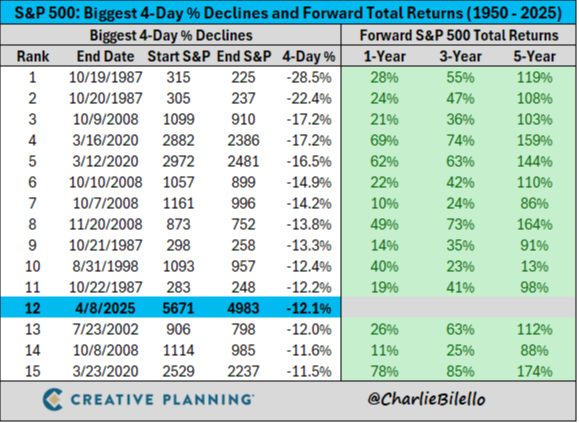
Source: https://x.com/charliebilello/status/1909707556660093386/photo/1
Over the past two decades, markets have faced steep declines—from the 37% drop in 2008 to the sharp swings of 2020 and 2022. Yet, each time, they’ve not only recovered but gone on to reach new heights, as seen in February 2025’s all-time highs.
Time In The Market Is More Important Than Timing The Market
Research suggests that missing a handful of the best days over longer time periods drastically reduces the average annual return an investor could gain by simply holding on to their equity investments during market sell-offs. Over the past 30 years, missing the best 30 days (based on S&P 500 Index returns from February 1, 1994, through January 31, 2024) took the annual average return from 8.0% per year down to 1.8%, which was less than the 2.5% average inflation rate over that same period.
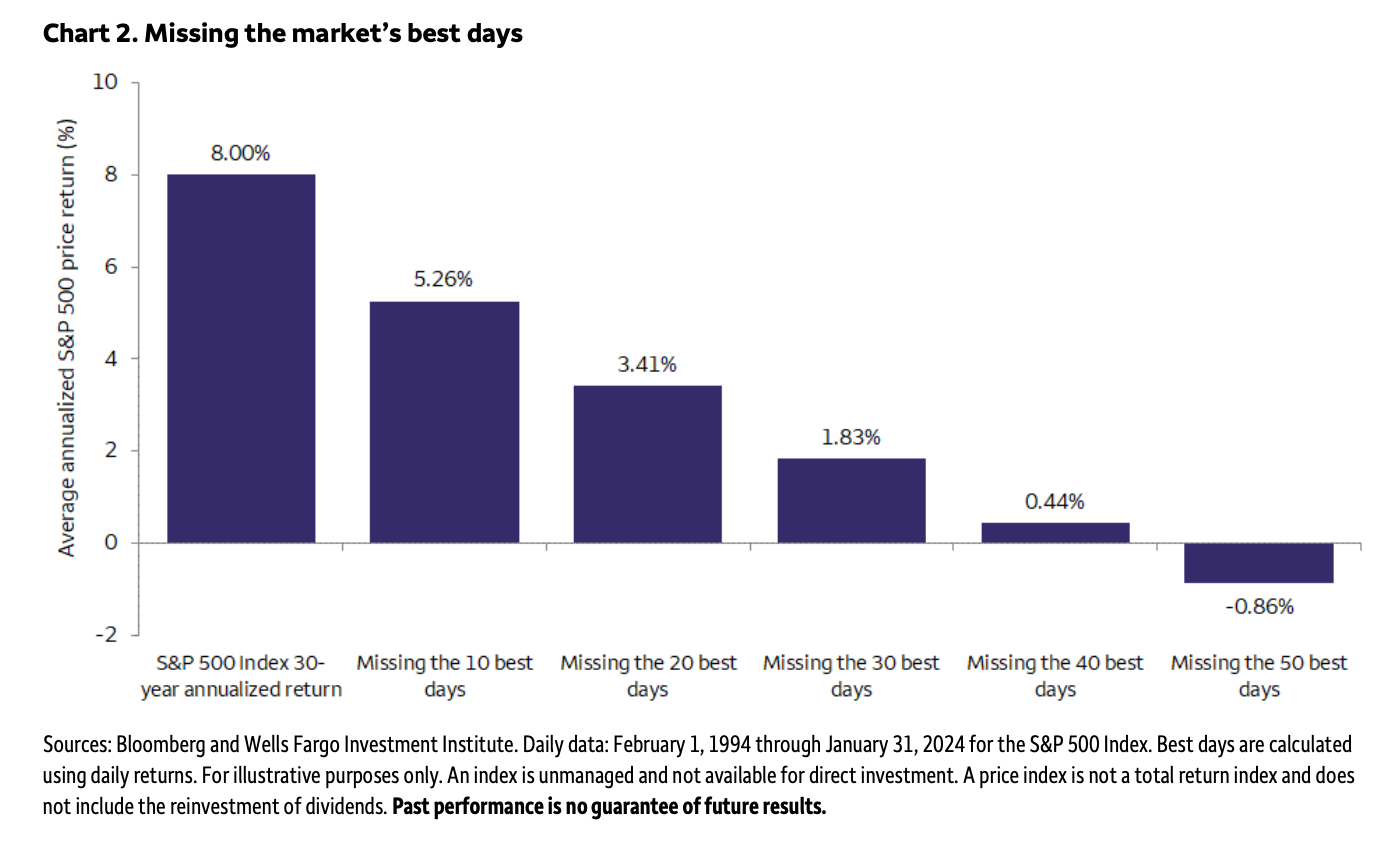
Not only that but timing the market can be difficult. According to Wells Fargo,
“The best days in the S&P 500 Index tend to cluster in the midst of a bear market or recession, and some of the worst days occurred during bull markets. Of the 10 best trading days in terms of percentage gains, all 10 took place during recessions and six also coincided with a bear market, with three of those in the 2020 recession and the remaining days during the Great Recession of 2007 – 2009”.
So What Does This Mean For You And Your Portfolio?
For investors (especially those in or nearing retirement), periods of volatility tied to tariffs or other events can be unnerving. It’s important to have a plan for navigating turbulent market
Here are questions to ask:
Have Your Plans & Goals Changed As A Result Of The Past Few Weeks?
If your financial goals, time horizon, and risk tolerance are the same as before, a market downturn on its own isn’t a reason to dramatically change course. History shows that staying invested through volatility is often wiser than trying to hop in and out of the market. If they have changed, we want to speak with you about it to develop an action plan.
What is an Action Plan?
Why are you investing? To outpace inflation and secure your financial future.
What is your risk tolerance? Recent market swings may have shifted your comfort level—let’s discuss.
When will you need your money? Align your portfolio with your goals and timeline.
Market pullbacks and corrections are a natural part of investing. On average, corrections of 10% or more happen fairly regularly, and bear markets (20% drops) occur once every few years on average. Each time the causes differ – one time it’s tariff – another time it’s something else.
Each time the market has recovered and moved higher. Keeping this perspective can help you avoid reacting in panic. If you are feeling anxious or uncertain, we’re here to help. Together, we can adjust your strategy to ensure it remains aligned with your objectives.
Disclosures:
The information herein was obtained from various sources. Vista does not guarantee the accuracy or completeness of information provided by third parties. The information in this report is given as of the date indicated and believed to be reliable. Vista assumes no obligation to update this information, or to advise on further developments relating to it.
Certified Financial Planner Board of Standards Center for Financial Planning, Inc. owns and licenses the certification marks CFP®, CERTIFIED FINANCIAL PLANNER®, and CFP® (with plaque design) in the United States to Certified Financial Planner Board of Standards, Inc., which authorizes individuals who successfully complete the organization’s initial and ongoing certification requirements to use the certification marks.
Securities offered through Level Four Financial, LLC, member FINRA/SIPC Vista Investment Partners II, LLC d/b/a Vista Investment Partners (“Vista”), is a federally registered investment adviser under the Investment Advisers Act of 1940. Registration as an investment adviser does not imply a certain level of skill or training. The oral and written communications of an adviser provide you with information about which you determine to hire or retain an adviser. ADV Part 2A can be obtained by visiting https://adviserinfo.sec.gov and search for our firm name. ADV Form 2B is available upon request. Neither the information nor any opinion expressed it so be construed as solicitation to buy or sell a security of personalized investment, tax, or legal advice.